Disaster triage
Five Days at MemorialDisaster triage is the sorting of patients and the allocation of scarce care or rescue capacity when an emergency overwhelms ordinary systems. In the account of Hurricane Katrina, the concept reaches beyond clinical judgments about who is most ill: it governs who is moved first, who must wait, and what a medical label is taken to mean. At Memorial Medical Center, the decision to put patients with do-not-resuscitate orders last altered an evacuation plan initially directed toward those most dependent on life support. The resulting conflict shows how a rule intended to organize scarcity can become a decision about access to rescue.
Definition and the Pressure of Scarcity
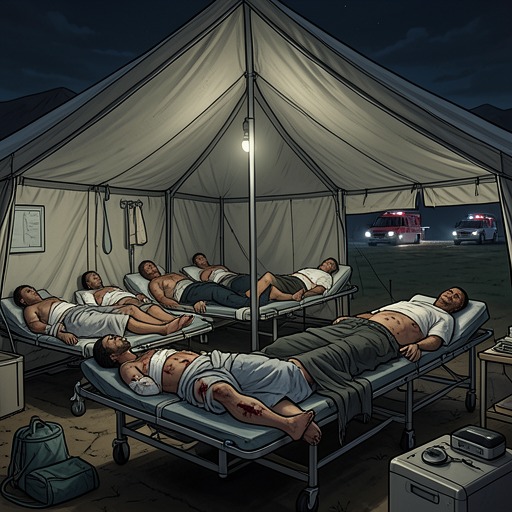
In an ordinary hospital, clinicians assess patients and arrange treatment within a functioning institution. During a disaster, those decisions become entangled with the limits of transportation, staffing, equipment, power, and time. At Memorial, nearly two hundred patients needed to be brought to safety as floodwaters threatened the hospital. The command group understood that the facility could not manage the unfolding emergency indefinitely and that the evacuation needed to move quickly.
The crisis extended beyond the hospital walls. New Orleans residents without cars or other ways to leave depended on public transportation plans that lacked enough drivers; traffic already obstructed the roads, and ambulances were overwhelmed by requests from hospitals, nursing homes, and homes. Acadian Ambulance had roughly two dozen ambulances available, but many were stuck on the interstate, and some began taking patients to the Louisiana Superdome rather than out of the city. A plan to evacuate patients therefore depended on a strained regional system, not simply on clinicians deciding what each patient needed.
That wider scarcity also shaped the experience of people who arrived at the hospital seeking help. An outpatient made her way through the floodwaters for a scheduled chemotherapy appointment, only to be told that treatment could not be given that day. A neighborhood resident overdue for dialysis reached the hospital through the water. These episodes place hospital patients, staff, and community members within the same emergency, but with sharply different access to organized care and evacuation.
Memorial’s Competing Priorities
At the hastily organized command meeting, Karen Wynn understood the situation as a race to act before the power failed. Susan Mulderick proposed moving the sickest patients first, particularly those dependent on life support or mechanical assistance. This group included about two dozen intensive-care patients, a similar number of newborns, high-risk pregnant patients, dialysis patients, and two bone-marrow-transplant patients vulnerable to infection. The proposal treated medical dependence as a reason for urgency: patients most exposed to the loss of hospital services should be moved before those more able to withstand it.
Doctors established an exception that reversed that priority for patients with do-not-resuscitate orders. Four such patients were in the intensive care unit, including Helen Breckenridge and Jannie Burgess. Richard Deichmann, who proposed the rule, later explained that he believed DNR patients had less to lose if disaster struck. Other doctors accepted the plan, with one reasoning that patients who had declined extraordinary measures would not want to be rescued at the expense of others. Yet neither the orders themselves nor Memorial’s disaster plans stated that DNR patients should be evacuated last.
The distinction mattered because a DNR order had a narrower meaning than the evacuation rule assigned to it. It directed clinicians not to attempt resuscitation if a patient’s breathing or heartbeat stopped; it did not itself request withdrawal of other care or refusal of rescue. A DNR order was also distinct from a Louisiana living will, through which a patient with a terminal and irreversible condition could request that life-sustaining procedures be withheld or withdrawn. Treating these different instructions as if they established a patient’s place in an evacuation queue converted a limit on resuscitation into a broader judgment about priority.
Labels, Consent, and the Meaning of Rescue
The practical effect of the DNR-last rule became visible as patients were moved toward evacuation. When transporters took a bed-bound patient toward a stairwell, they stopped after seeing her DNR order and repeatedly moved other patients around her. Staff were instructed not to tell her daughter that the order was the reason. When the patient’s condition and circumstances changed in the daughter’s eyes, she asked for the order to be canceled. The daughter had approved a limit on resuscitation, but did not understand it as a request that her mother be left behind. Staff sought a doctor to remove the order, and the patient was moved toward rescue.
A similar problem confronted Angela McManus, whose mother, Wilda, was at LifeCare. After hearing that DNR patients would wait, she wanted to rescind her mother’s order but was told that no doctor was available to do so. The contrast between the daughter who could obtain a change and the daughter who could not underscores how a nominally individual medical directive could govern evacuation while the opportunity to revise it depended on circumstances and access to a doctor.
Jannie Burgess’s history adds another dimension to the rule’s apparently neutral operation. She had worked for thirty-five years as a practical nurse in New Orleans hospitals and nursing homes, yet her light-brown skin had once barred her from receiving care at private hospitals where she could treat patients. Memorial’s predecessor was among the last Southern hospitals to integrate, refusing federal hospital programs in the 1960s rather than accept their nondiscrimination requirements. During the Katrina evacuation, Burgess herself was among the DNR patients assigned lower priority. The book does not make her earlier exclusion the cause of that decision; it places the decision within a history showing that access to care had not been equal even before the emergency.
Outcomes and Ethical Stakes
The evacuation strategy did not remain fixed. As conditions changed, boats were used for relatively few patients who were well enough to be discharged, as well as for employees and relatives. Meanwhile, the sickest patients waited. On the second floor, exhausted staff were told to leave a DNR patient behind. Her daughter then requested that the order be discontinued, explaining that she had not intended it to mean that her mother should not be rescued. The patient was taken downstairs and toward the helipad. Such cases make clear that evacuation triage was not only a ranking performed at a meeting: it affected what patients and families were told, when a patient could be moved, and whether an existing order could be reconsidered.
The consequences of delay and institutional failure were not confined to Memorial. The account attributes New Orleans’s deaths and prolonged suffering to interacting causes, including delayed evacuation, shortages of buses and drivers, uncoordinated rescue, poor communications, and hospitals and nursing homes that had not evacuated before the storm or invested in sufficiently robust backup power and water systems. It also describes how fear of lawlessness interrupted rescue efforts. In this setting, triage operated inside a broader breakdown that constrained choices before any individual patient was classified.
The lasting burden is also reflected in the experiences of staff. Gina Isbell described poor sleep, nightmares of patients’ faces, the loss of her home and community in St. Bernard Parish, and guilt about the staff she had scheduled and the patients who died. Karen Wynn found that preparing for possible grand-jury testimony could make discussion of the events feel like reliving them; she recognized lasting trauma in herself and colleagues and no longer wanted the responsibility she had carried at the hospital. These accounts do not settle the ethical questions raised by the evacuation rule, but they show that triage decisions and their aftermath remained part of the workers’ lives long after rescue ended.
Disaster Triage Beyond Memorial
The book later places emergency allocation in a different setting: a field hospital in Port-au-Prince after the 2010 Haiti earthquake. There, a woman whose real name was Nathalie LeBrun was recorded as Jane Doe 326 because the team struggled to record unfamiliar names. She needed oxygen, but the supply was unreliable: a tank ran out, another was found, and a portable concentrator repeatedly overheated while fuel for generators was scarce. The episode does not repeat Memorial’s evacuation rule. Instead, it shows another constraint on disaster care: scarce and unstable supplies can make continued treatment depend on logistics as well as clinical need.
Together, the scenes distinguish triage as a necessary response to scarcity from any particular rule used to distribute risk. A ranking can appear administratively clear while resting on mistaken assumptions about a patient’s wishes, the meaning of a medical order, or what evacuation is likely to achieve. The Memorial crisis makes the consequences concrete: when a DNR designation was used to place patients last, a directive against resuscitation came to function as a reason to delay rescue. Disaster triage is therefore presented not as a neutral sorting mechanism, but as a set of consequential choices made within fragile systems, under pressure, and with unequal room for patients and families to respond.